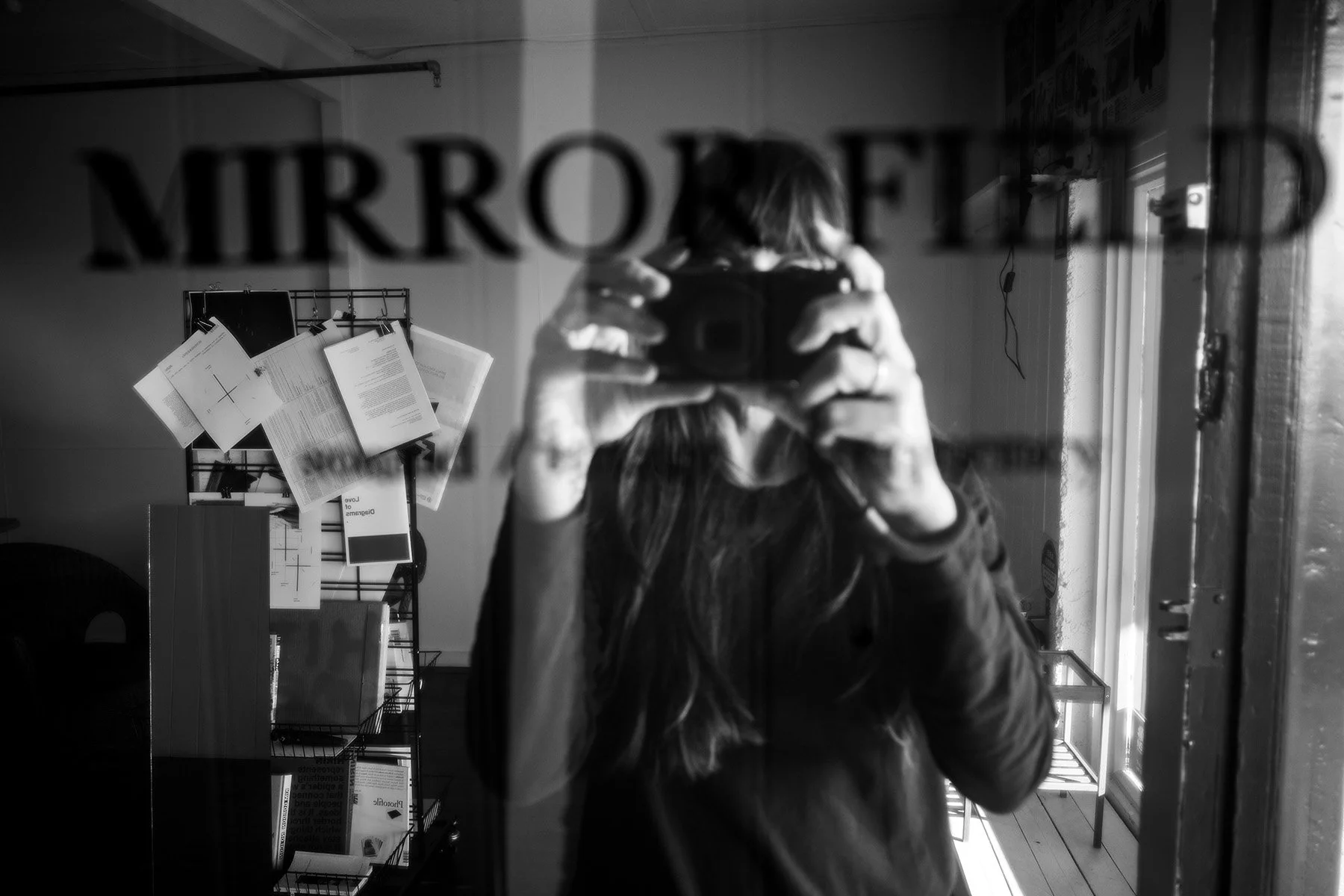
through the mirror field
a left brain / right brain response
to the residency and mentorship by artists,
Natasha Dusenjko and Liberty (E.B Kerr)
by Liz McCrystal
Lightning doesn’t strike the same place twice
But sometimes it feels that way when you uncover a likeminded soul living in the same geographic isolation.
Cultural infrastructure of metropolitan areas, the ones you would rely on to relieve your anonymity are now gone.
A needle in a hay stack also comes to mind.
You are the needle.
Mirror Field began, at least officially, as a three-month mentorship and residency between NSW, Far South Coast artists Natasha Dusenjko and Liberty Kerr. On paper, the project proposed an investigation into improvisation, sound, image and publication through collaborative jam sessions, discussions and experimental processes operating out of a shop-front, turn temporary artist studio in Narooma, NSW, a regional, coastal town about five hours south of Sydney. Yet almost immediately, the project resisted the tidy logic of outcomes. Rather than narrowing towards a final resolution, the residency opened outward, becoming less an attempt to solve an artistic question than to remain inside one. This refusal of an outcome feels central to the work itself.
Situated on Narooma’s main street, the residency occupies an unusual space: a commercial business with a fully mirrored exterior reflecting passing traffic, pedestrians, neighbouring businesses and glimpses of the ocean beyond. The effect is disorientating, the street folds back onto itself, cars slide through fragmented reflections. Bodies pause to adjust their hair, take selfies or peer uncertainly through the glass. The building simultaneously announces and conceals itself. The signage on the door participates in it’s ambiguity. Declaring the temporary studio a “centre for sound/image/frequency,” the typography performs the authority of institutional language while simultaneously parodying it. Dusenjko describes the signage as “simultaneously true and absurd.” A temporary experimental studio is elevated to the status of official cultural institution, yet the gesture remains knowingly tongue-in-cheek. The sign becomes both documentation and artwork, both invitation and conceptual joke.
I caught my tongue on the tread between thinking and action.
No one asked for the window I was about to erect.
Everyone has opinions, me most of all.
In the end, I was fretting over something others would only walk or scroll past.
Making is an isolated endeavour.
The mirrored façade collapses distinctions between artwork and environment. The street becomes implicated in the work whether it intends to or not. Yet Dusenjko insists she was not attempting to dissolve the boundary between art and everyday life so much as “boundaries in general.” Art, daily life, performance, investigation, self-consciousness, chance encounters and passing traffic begin to occupy the same unstable field.
This instability is perhaps best understood through the idea of the precipice, not necessarily as danger, but as threshold. Mirror Field exists on the edge of multiple crossings: between inside and outside, visibility and concealment, public and private, process and outcome, experimentation and uncertainty. To enter the space is to cross both a literal and psychological line. The mirrored glass amplifies this tension.
Outside: transactional rhythms of a regional town.
Inside: unresolved investigations into sound, image, perception, process.
Impossibly thin is the membrane between these worlds.
Experimental sound and conceptual art often occupy an uncertain position outside metropolitan centres, where audiences may have fewer frameworks through which to interpret non-traditional artistic practices. Regional arts communities are frequently imagined through the language of accessibility, representation or cultural service, while more ephemeral, process-driven or conceptual modes of practice risk being perceived as obscure or inaccessible. Yet Mirror Field quietly challenges this assumption.
What emerges throughout the residency is not alienation but curiosity. Dusenjko reflects that people proved “more curious and willing to engage than we imagine.” This curiosity reshaped the project itself. Confronted with the difficulty of verbally explaining an unresolved investigation to passing visitors, she began assembling reading materials within the space: essays, texts, notes and eventually her own Field Notes. Using abandoned retail display furniture left behind by the former tenant, she constructed a mobile library that became both sculptural object and conceptual extension of the residency. The library expanded through community contributions, creating an interface between the inner investigative space and the wider community.
The irony is: we left the city for more freedom
to experiment; with life / time and of course, art.
Washing up on the shores of a new community is like jumping the guardrails. With quiet attention you soon discover paths left by others
those who preferred to walk backwards too.
Mirror Field seems to operates through propositions rather than declarations, preventing the residency from becoming overly fixed or didactic. This is where Liberty Kerr’s influence becomes most visible. Kerr’s long engagement with improvisation, experimentation and chance as foundational creative principles appears to have shifted the residency away from production-based outcomes and towards process itself. Rather than engineering definitive integrations between sound and image, the collaborators allowed uncertainty, interruption and limitation to guide the work. Thin walls, bouncing sound, street noise and spatial restrictions all became active agents within the residency’s conceptual terrain.
Importantly, sound here is not treated as accompaniment but as atmospheric pressure and spatial event. Kerr’s experimentation with layered recordings from multiple devices; phones, cameras and Zoom recorders introduced the possibility that the space itself might function as a resonant instrument. Dusenjko describes recordings that captured “the sounds of the space, like a vibrating mirror.” The mirror ceases to be merely visual and begins to operate acoustically and conceptually.
Dusenjko extends the pulse of this project beyond the physical studio and into digital space. Throughout the residency, Instagram has functioned less as a promotional tool and more as a process diary. Her use of the platform is one directional; engagement as traces in the form of photographs, fragments of text, video snippets, observations, references and fleeting moments of recognition. The comparison of Instagram with the mirror feels unavoidable. Both operate through reflection. Both create the illusion of endless extension. The infinite scroll of Instagram mirrors the seemingly infinite reflection of a mirror encountering itself. Neither offers a final image. Both remain perpetually unfinished.
Two worlds / two-way mirror
Reflection / distortion
Copy, copy cats.
Life goals / body hacks.
Purchase my PDF
Save and send to myself
Digital loitering / wondering / stalking / imagining / branding
Perception / misinterpretation
Black out for lack of engagement
Community turn communal punishment
Mirror Field refuses to settle into singular form. It may become a publication, a sound work, an archive, a score, an installation, an unfinished proposition or all of these simultaneously. Rather than failure of resolution, this openness becomes the work’s conceptual achievement. Dusenjko describes arriving at clarity “via negativa” through negation, through understanding what the work does not need to become.
In this sense, Mirror Field does not simply document experimentation; it performs it. The project asks what happens when an artistic practice stops orienting itself around outcome and instead commits to sustained attention and uncertainty. What happens when a regional shopfront becomes less a venue and more a membrane? What happens when sound leaks through thin walls, mirrors absorb the street, libraries emerge from discarded retail furniture, and passing strangers unknowingly enter the artwork simply by looking?
For three months on Narooma’s main street, Mirror Field transformed a commercial space into a reflective surface through which the boundaries between artist, audience, environment and process became increasingly unstable. The work did not offer answers so much as intensify awareness of the thresholds already surrounding us. Perhaps this is the true field the project maps: not the mirror itself, but the strange and disorienting space just beyond it.
Talking to you is like catching déjà vu.
I turned it over in my hands / examine its dance.
Scrapping to save seeds
Sand sculpture ramblings
High tide incoming
June 2026
This project is supported by the NSW Government through Create NSW in association with the Regional Arts Fund, which supports the arts in regional and remote Australia.